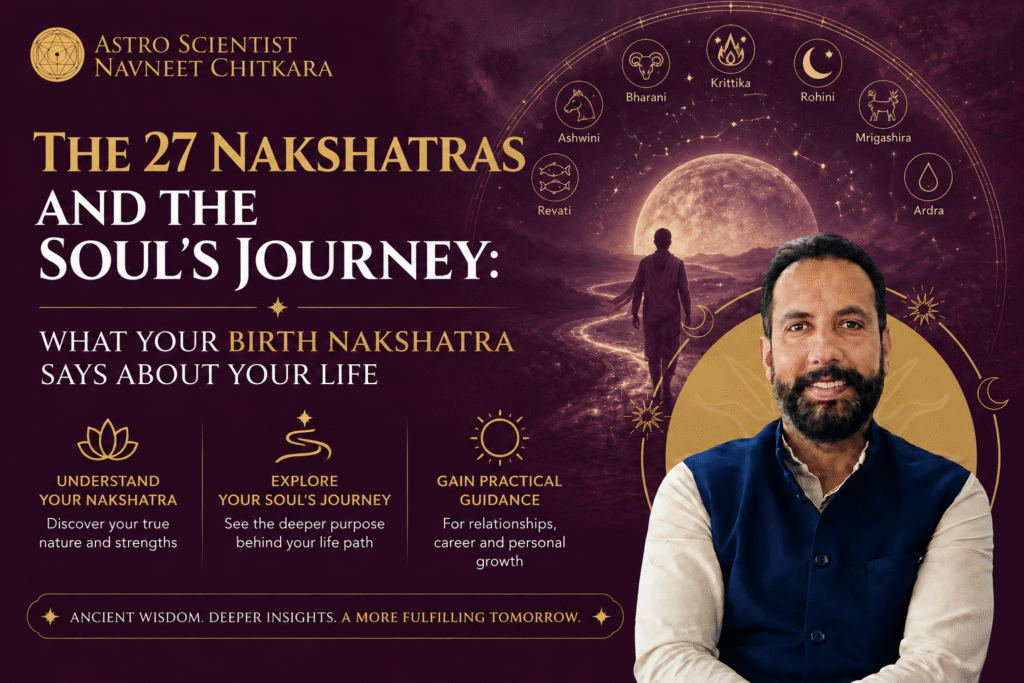
There is a very different way of looking at the Nakshatras.
Most of us learn them as names to be memorized. Ashwini means this. Bharani means that. Rohini is associated with something else.
But what if the 27 Nakshatras are not merely 27 definitions?
What if they tell a story?
A story that begins before birth, moves through childhood, relationships, ambition, responsibility and ageing—and eventually returns to the point from which the soul began its journey.
This is the way I like to look at the Nakshatras.
As a story of the soul.
In Vedic astrology, the birth Nakshatra can be studied for much more than personality. It can offer a way of understanding karmic patterns, unfinished experiences and the larger purpose associated with a particular birth.
So instead of explaining the Nakshatras as isolated concepts, let us understand them as chapters in one continuous story.
Every Birth Is an Unfinished Story
Consider a person who has lived a full life.
They had a family. They built a home. They created a business. They formed attachments. They accumulated experiences.
Then comes death.
From the perspective of the soul, the story may not necessarily feel complete.
Perhaps there is still attachment to the family.
Perhaps there is unfinished work.
Perhaps there is something the soul still wants to experience.
The next birth can therefore be understood as the continuation of that story.
The previous life becomes the chapter before the interval.
This life becomes the chapter after it.
And the interval is what we call death.
The story continues.
This is the philosophical foundation from which Navneet Ji approaches the Nakshatras in the discussion.
Nakshatras: The Doors Through Which the Soul Enters
There are 27 Nakshatras, and each has four Pandas or Charanas.
A useful way to understand this is to imagine entering a cinema.
There are different doors.
The ticket determines where you enter.
In the same way, the soul enters through a particular Nakshatra and Pada, carrying with it a particular karmic framework.
The body is the vehicle.
The planets become the medium through which experiences reach us.
The houses show where those experiences unfold.
And the Nakshatra can be understood as the place from which that karmic material is being delivered.
Navneet Ji uses the analogy of a storehouse: the Nakshatra is like a vast karmic warehouse from which experiences are delivered to us through the planetary system.
That is why two people can have a similar planetary placement and yet experience life very differently.
The story behind the planet matters.
1. Ashwini — The Wait
The journey begins with Ashwini.
Imagine a soul waiting to take birth.
It has selected a family. It has unfinished karma. It is waiting for the circumstances to become suitable.
That waiting is Ashwini.
And this is why Ashwini carries such a strong quality of speed.
The moment the opportunity appears, there is an urgency to enter.
Wait first. Then move quickly.
This is also why complications and uncertainty can appear around the area of life where Ashwini operates.
For example, Navneet Ji explains that Ashwini in the 7th house can create complications before marriage—the person may struggle with the question of which direction to take.
Ashwini in the 10th house can create a professional tug-of-war:
Should I do this? Or should I do that?
Ashwini in the 3rd house can create a similar internal debate around communication.
And in the 11th house, hopes, wishes and desires can keep shifting:
Is this really what I want? Or is that better?
The theme remains the same:
The search before the decision.
2. Bharani — Dependence and Nourishment
Once the soul has found the body, the story changes.
Now there is complete dependence.
The child is in the mother’s womb.
It cannot move independently.
It receives nourishment from the mother.
It is protected, but it is also dependent.
That is Bharani.
So when Bharani influences a house, the area represented by that house can become an area of dependence.
Bharani in the 7th can bring dependence on the spouse.
In the 2nd, dependence can be connected with family.
In the 4th, the mother can become particularly important.
In the 5th, children may become strongly dependent—or the native may become deeply dependent on their children.
In the 9th, the influence may extend towards teachers, gurus, father figures or authority.
And there is another quality to Bharani:
movement can take time.
Navneet Ji compares it to being stuck in a traffic jam.
You will eventually reach your destination, but not with the speed of Ashwini.
That distinction is important when reading the Nakshatra through a horoscope.
3. Krittika — Separation and Hunger
Then comes birth.
The umbilical cord is cut.
The child is separated from the complete dependence of the womb.
This is Krittika.
Krittika is about cutting.
But immediately after that separation comes another powerful experience:
hunger.
The newborn cries.
It wants milk.
Nothing else matters until that hunger is satisfied.
This becomes the central metaphor of Krittika.
The desire to have something.
The hunger to achieve.
The insistence on results.
This is why Navneet Ji connects strong Krittika influence with people who can be extremely result-oriented.
They may become demanding leaders or professionals because their internal attitude is simple:
“I need the result.”
The hunger can also manifest through food, sexuality, creativity or achievement.
It is not always literal hunger.
It is the hunger to fulfill a desire.
4. Rohini — Love, Taste and Uniqueness
The child grows.
Around three or four years of age, something changes.
The child begins discovering preferences.
Music.
Food.
Color.
Art.
People.
The child begins saying:
“I like this.”
And:
“I don’t like that.”
This is Rohini.
Rohini is connected with love, emotion, creativity, taste and individuality.
Every child develops a unique preference.
And this uniqueness is important.
According to the discussion, Rohini-influenced people may not be comfortable simply copying others. They want things in their own way.
But Rohini also brings expectations.
As the child grows, everyone begins asking:
What will you become?
What will you do?
What will you achieve?
The person may therefore find themselves carrying expectations from family, society or even a larger public.
This combination of uniqueness + creativity + expectation becomes an important Rohini theme.
5. Mrigashira — The Search
Then the child grows older.
School becomes more complicated.
There are more subjects.
More sports.
More friends.
More choices.
The world suddenly becomes much larger.
And one question begins repeating:
“Which one?”
Which school?
Which subject?
Which career?
Which sport?
Which possibility?
This is Mrigashira.
Mrigashira is the search.
It creates curiosity and exploration, but it can also create a feeling that something is still missing.
This is why people with a strong Mrigashira influence can remain in a constant quest.
They find one possibility.
Then another appears.
Then another.
The search continues.
Mrigashira teaches us what happens when having more choices does not necessarily make choosing easier.
6. Ardra — Knowledge Through Turbulence
Around adolescence, the nature of the experience changes again.
Now you begin seeing what is wrong.
And, more importantly, you begin telling other people that they are wrong.
This is Ardra.
Ardra is associated in Navneet Ji’s explanation with knowledge, turbulence and the ability to identify mistakes.
But there is a problem.
Most people do not like being told where they are wrong.
A teenager tells the parents:
“You’re wrong.”
A spouse tells the other:
“You are doing this incorrectly.”
A friend points out another friend’s mistake.
And suddenly, what began as knowledge becomes conflict.
That is Ardra.
The lesson is not to stop seeing what is wrong.
The lesson is to learn how to communicate what you know.
Navneet Ji particularly recommends meditation and devotion to Mahadev for those strongly influenced by Ardra, because otherwise the tendency to continuously correct others can eventually create suffering for the person themselves.
7. Punarvasu — Stability and Giving
After the turbulence of adolescence comes a quieter phase.
You have completed school.
You know what you want to study.
You begin thinking about career and identity.
This is Punarvasu.
Punarvasu represents stability after turbulence.
It also carries a strong quality of helpfulness and sacrifice.
There is a desire to help.
To give.
To support.
But Punarvasu can also bring repetition.
The same classroom.
The same routine.
The same examinations.
The same cycles.
Life begins developing a rhythm.
And that rhythm prepares you for the next stage.
8. Pushya — The First Experience of Giving
Then comes the first salary.
For many people, the first salary is not really about themselves.
They buy something for their mother.
Something for their father.
A gift for a sibling.
Something for a grandparent.
This is Pushya.
The experience of nourishing someone else.
Earlier, you were the one receiving nourishment.
Now you have the ability to provide it.
But Pushya has a karmic lesson.
When we give, the ego can quietly enter.
I gave this.
I did that for you.
I have done so much.
The act of giving can become a source of superiority.
So the lesson of Pushya is not merely:
Give.
It is:
Give without becoming arrogant about your ability to give.
That distinction is central to Navneet Ji’s interpretation.
9. Cashless — Comparison, Attachment and Toxicity
By the late twenties, another major chapter begins.
Career has started.
Education is largely complete.
Parents have been supported.
And now marriage becomes a serious consideration.
This is Cashless.
You begin looking at other people’s lives.
Their marriage is happy.
They have a beautiful house.
Their partner is settled.
Their lifestyle looks successful.
And then comes the desire:
“I want that too.”
Cashless can therefore create a tendency to copy what we see around us.
But its deeper lesson is more difficult.
Sometimes we become attached to relationships even when we know they contain toxicity.
We recognize the problem.
We still stay.
We carry the metaphorical poison in our own throat.
This is why the serpent symbolism associated with Cashless becomes so meaningful in Navneet Ji’s explanation.
The question is not only:
“Why am I surrounded by toxic circumstances?”
It is also:
“Why am I continuing to carry them?”
And with Cashless, that brings us to the next chapter.
The Story Does Not End Here
By the time we reach Cashless, the soul has moved from waiting to dependence, from dependence to birth, from hunger to individuality, from curiosity to knowledge, from knowledge to responsibility and finally into relationships.
But this is only the first movement of the story.
The individual is now around thirty.
They have built something.
They have responsibilities.
They have a family.
And suddenly, another thought begins to emerge:
“I have done enough for the ordinary things. Now I want to build something larger.”
That is where Magha begins.
And that is the story of the second stage of the Nakshatra journey.
The interpretations above follow the framework presented by Navneet Ji in the podcast and are intended as an educational exploration of Nakshatra symbolism, not as standalone predictions.