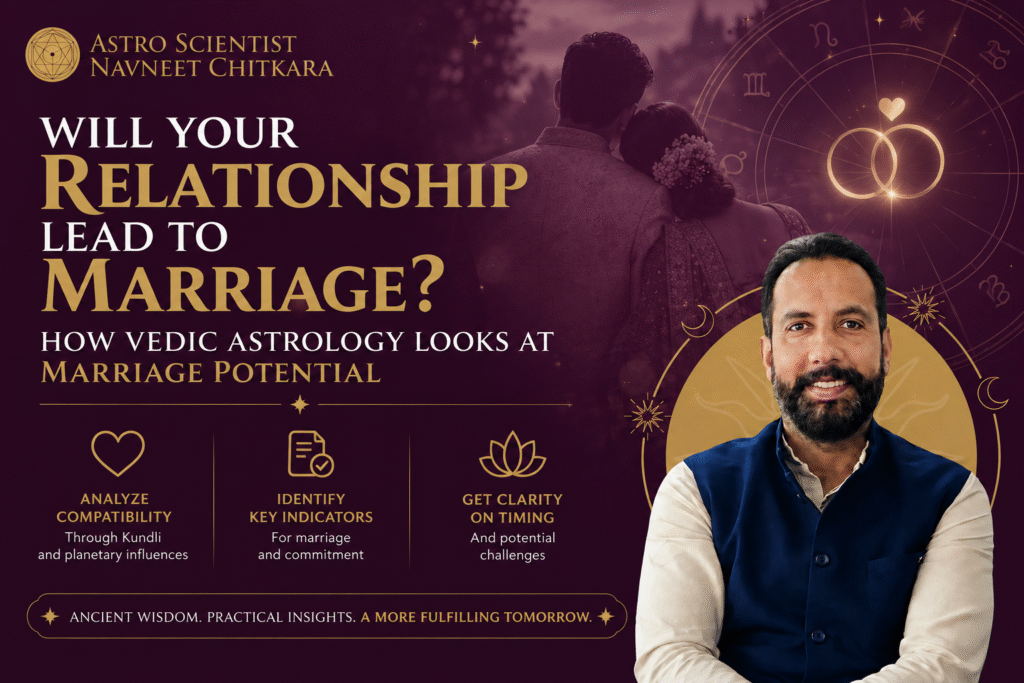
Being in a relationship and getting married are two different things.
You may love someone.
You may have spent years together.
You may genuinely believe that the two of you belong together.
And yet, one question can remain:
Will this relationship actually culminate in marriage?
This is one of the most sensitive questions in relationship astrology because it is not simply about compatibility.
It involves intention, circumstances, timing and commitment.
According to Astro Scientist Navneet Chitkara, there is no single formula that should be used to answer this question. However, there are specific astrological approaches that can help an astrologer understand whether a relationship has the potential to move towards marriage.
Prashna Kundli: When the Question Itself Becomes the Starting Point
One of the methods Navneet Ji places considerable trust in is Prashna astrology.
The principle is quite different from simply reading someone’s birth chart.
Suppose you ask:
“Will I marry this person?”
The astrologer can construct the horoscope for the moment the question is actually asked.
And there is an important detail.
The horoscope is created for the place and time of the astrologer receiving the question, not necessarily the location of the person asking it.
If someone sitting in America asks the question to an astrologer sitting in India, the astrologer would use the time and location where the question was received.
That moment becomes the basis of the Prashna Kundli.
Navneet Ji also emphasises that Prashna is a vast branch of astrology in itself and cannot be reduced to a few rules.
What Does the Ascendant Say in a Marriage Prashna?
For a broad understanding, the nature of the ascendant becomes one of the first things to examine.
If the ascendant is a fixed sign—Taurus, Leo, Scorpio or Aquarius—the possibility of the relationship progressing towards something stable can be stronger.
But that is only the beginning.
The astrologer must then examine the ascendant lord and seventh lord, because the question is specifically about marriage.
The seventh lord’s sign also matters.
If it falls in a fixed, movable or dual sign, it adds another layer to the interpretation.
A dual sign can bring uncertainty:
Maybe. Maybe not.
A movable sign can make the situation more unsettled.
A fixed sign can provide greater stability.
But none of these factors should be interpreted independently.
The Seventh House Still Matters
When the question is marriage, the seventh house cannot be ignored.
The seventh house and its lord become important indicators of whether the relationship has the potential to move towards marriage.
The Upapada Lagna can also be considered.
Its lord, planets placed in it and the second house from it can provide additional information.
Darakaraka can also be examined as part of the larger picture.
This is where a proper astrological analysis becomes different from an internet prediction.
There is no single placement that can responsibly answer:
“Yes, you will marry this person.”
The answer comes from the combination of several indications.
Why the Navamsa Is So Important
The next layer is the Navamsa, or D9 chart.
Navneet Ji gives a particularly interesting interpretation of the Navamsa ascendant.
It can indicate a person’s attitude towards marriage.
And that is not always the same as what they show outwardly.
A person may tell everyone:
“I want to get married.”
But internally, they may not be ready.
Another person may appear casual but actually be deeply committed to the idea of marriage.
The birth chart can show the external scenario.
The Navamsa can provide insight into the internal environment.
That distinction is extremely important when trying to understand whether a relationship can become a marriage.
What Different Planets Can Show in the Navamsa Ascendant
Navneet Ji explains that planets influencing the Navamsa ascendant can describe different attitudes towards marriage.
Saturn and Rahu
If the Navamsa ascendant is badly afflicted by combinations such as Saturn-Rahu, or Mars-Ketu, the person’s attitude towards marriage may not be particularly supportive.
The person may not be mentally prepared.
Mercury
Mercury can bring a more casual or youthful approach.
The person may say:
“Yes, I’m thinking about marriage.”
But then there is always another condition:
“I’ll do it after I achieve this.”
“I’ll do it once I reach that level.”
The commitment keeps getting postponed.
Jupiter
Jupiter can indicate a much more positive approach towards marriage.
The person may genuinely be serious about commitment.
Sun
The Sun can also indicate a positive approach, but with a more dominant quality.
The attitude can be:
“I will marry—but I will decide when and how.”
Mars
Mars can make the approach more impulsive, aggressive or argumentative.
A person may say:
“I don’t want to get married.”
And then, very suddenly:
“Fine. Let’s get married.”
Venus
Venus can bring devotion towards marriage.
Moon
Moon can bring a romantic and emotionally devoted attitude.
These are tendencies, not permanent labels. The complete chart still has to be examined.
Attitude Is Not the Same as Circumstances
This is perhaps one of the most valuable insights in the entire discussion.
Suppose Jupiter is influencing the Navamsa ascendant.
The person’s attitude towards marriage is positive.
But what if the Navamsa ascendant lord is badly placed?
Then the attitude may be good while the circumstances surrounding marriage may be difficult.
For example:
- Families may oppose the relationship.
- There may be communication gaps.
- Both families may struggle to agree.
- There may be unnecessary delays.
- External circumstances may make marriage difficult.
So Navneet Ji makes an important distinction:
Navamsa ascendant → attitude towards marriage
Navamsa ascendant lord → circumstances surrounding marriage
This distinction makes the analysis considerably more nuanced.
What About Marriage Timing?
Even when the attitude is positive and the circumstances are manageable, timing matters.
Navneet Ji explains that when assessing marriage timing, the first, second and seventh houses become important.
Their planetary periods can become relevant through Mahadasha and Antardasha.
The approach discussed is that the Mahadasha can be examined from the birth chart, while the Antardasha can provide more specific information through the divisional chart, particularly the Navamsa.
So the astrologer is essentially asking:
Is the attitude supportive?
Are the circumstances supportive?
Is the timing supportive?
If all three come together, the possibility of marriage becomes considerably stronger.
If one is disconnected, delay or difficulty may appear.
What If the Relationship Is Right but the Time Is Not?
This is where astrology can be genuinely useful.
You may be with the right person.
The intention may be genuine.
But the timing may not yet support marriage.
Perhaps the individual wants to marry within six months because of family pressure.
But the planetary periods do not show marriage within that timeframe.
In such a situation, the role of an astrologer is not to create false hope.
It may be to say:
“You may need to wait.”
And sometimes that clarity is more valuable than a comforting prediction.
Can Spiritual Practice Help?
Navneet Ji also discusses the role of sadhana, mantras and devotional practices when the horoscope indicates delay or difficult circumstances.
The point, however, is not simply to perform a ritual mechanically.
He places strong emphasis on shraddha—faith and sincerity.
He gives the example of the traditional practice of observing sixteen Mondays.
The question is not merely:
“Did you complete sixteen Mondays?”
The deeper question is:
With what intention did you do it?
The Most Important Shift: From Taking to Giving
This is one of the most distinctive insights from Navneet Ji’s discussion.
When people pray for marriage, they often ask:
“What kind of husband will I get?”
“What kind of wife will I get?”
“What will this marriage give me?”
Navneet Ji suggests changing the question.
Instead of asking:
“What will I get from this marriage?”
ask:
“What am I willing to contribute to this marriage?”
The difference is profound.
You are not simply asking God for a good spouse.
You are approaching the relationship with the intention of giving.
Giving respect.
Giving commitment.
Giving honesty.
Giving transparency.
Giving companionship.
According to the philosophy shared in the discussion, when the attitude changes from taking to giving, the way we approach marriage itself changes.
Respect and Transparency in Marriage
Navneet Ji places particular emphasis on respect and commitment.
A marriage cannot thrive if both people enter it thinking only about what they will receive.
He also speaks strongly about transparency between partners.
The deeper idea is that marriage requires a shared sense of openness rather than creating separate emotional worlds.
The relationship should not become:
“This is my private world and that is yours.”
The couple has to build a shared space of trust.
That is where commitment becomes real.
Is the Person You Are Dating Your Future Spouse?
Astrology can provide indications.
But it should not be used as an excuse to stop observing the actual relationship.
Look at the person.
Look at their actions.
Look at their commitment.
Look at how they handle conflict.
Look at whether their behaviour aligns with their words.
Then astrology can provide another layer of understanding.
The strongest approach is not:
Astrology OR common sense.
It is:
Astrological insight + awareness + personal responsibility.
Final Thoughts
The question:
“Will I marry this person?”
sounds like it should have a yes-or-no answer.
But marriage is rarely that simple.
A serious astrological analysis can look at:
Prashna → seventh house → seventh lord → Upapada Lagna → Navamsa → attitude → circumstances → Dasha → timing.
Each factor tells a different part of the story.
And perhaps the greatest value of astrology is not giving us absolute certainty.
It is giving us enough clarity to make wiser decisions.
Sometimes the answer is:
Yes, the circumstances are supportive.
Sometimes:
Not yet.
Sometimes:
The relationship may be genuine, but marriage is not currently supported.
And sometimes the most important guidance is not about finding someone at all.
It is about preparing yourself to give when the right relationship arrives.
This article is intended for educational purposes. Marriage prediction requires analysis of the complete horoscope and should not be based on a single placement or isolated rule.